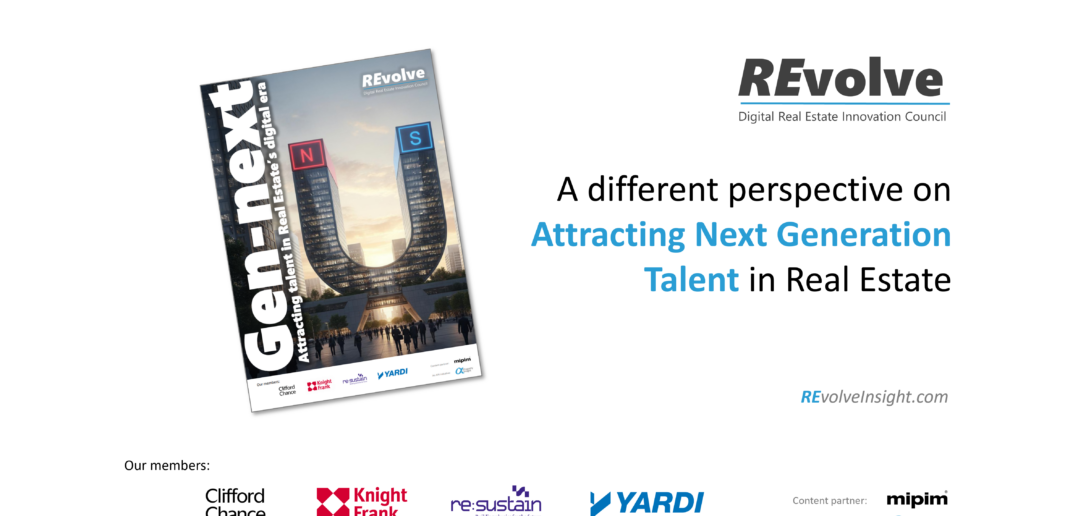
In today’s digital world, how can real estate attract the next generation of talent? A new report from REvolve Insight explores how the sector can stay competitive as a top career choice for young professionals.
Gen-next: attracting the next generation of talent in real estate’s digital era
The real estate sector stands at a crossroads. Long regarded as a secure and rewarding career, it now faces a new challenge: how to attract and retain the next generation of talent in an era defined by rapid technological change, shifting work expectations and evolving values.
Today’s young professionals are driven by purpose, flexibility and innovation. Most are digital natives, seeking careers where they can make an impact and use cutting-edge technology. Real estate must now compete for their attention against sectors that are sometimes perceived as more dynamic, technology-led and forward-looking.
The good news is that real estate has an extraordinary story to tell. It shapes our homes, workplaces and communities. It drives economies and holds the key to tackling some of the greatest challenges of our time, from decarbonisation to urbanisation. In this digital era, real estate must, however, redefine how it presents itself as a career destination.
Perception and generational divides
Despite progress, the industry still faces a perception challenge. It can be seen by some as traditional, slow to innovate and resistant to change. At the same time, the long-standing structure of the sector can contribute to a generational divide where experience is valued over expertise. For younger professionals, with the latest digital skills, this can be discouraging. However, two-way mentoring, where junior staff and senior leaders can share their relevant experience and inclusive learning environments could help bridge that divide.
What young talent wants
Purpose has become a decisive factor for younger generations. They want their work to contribute to sustainability, diversity and social progress — not as add-ons, but as core business principles. Real estate can compete strongly on purpose: it shapes cities, supports decarbonisation and improves communities.
Flexibility also plays a central role. Hybrid working is often now an expectation rather than a perk. Adopting flexible work structures is now seen as a critical factor by many in securing and developing young talent in real estate.
Impact of AI
AI is redefining roles and workflows. While it creates efficiency, it also risks removing the entry-level tasks that once served as vital training grounds for young professionals. The report urges firms to redesign learning pathways — combining foundational manual experience with AI-supported work — so that the next generation develops both technical fluency and professional judgement.
Actions for the sector
To attract and retain future talent, the report calls on the industry to act decisively:
- Future Flexibility: Consider flexible work structures that balance collaboration, autonomy and growth.
- Future Skills: Embed digital and AI training across all levels, not just junior roles and encourage reverse mentoring to share digital skills.
- Future Technology: Encourage curiosity, experimentation and innovation through “safe-to-fail” learning spaces.
- Future Perception: Reiterate that real estate is purposeful, inclusive and tech-driven.
To read the full report, visit https://www.revolveinsight.com/
REvolve brings together leading names in the sector to explore some of the sector’s challenges and the role that technology plays in driving or solving these challenges. MIPIM is REvolve’s content partner, alongside members Clifford Chance, Knight Frank, re:sustain and Yardi.